Home › What we buy › World coins
Selling world coins in Jacksonville
Coins from deployments, ports of call and family overseas. We sort them by country and metal and tell you which ones hold silver, which hold gold and which are only souvenirs.
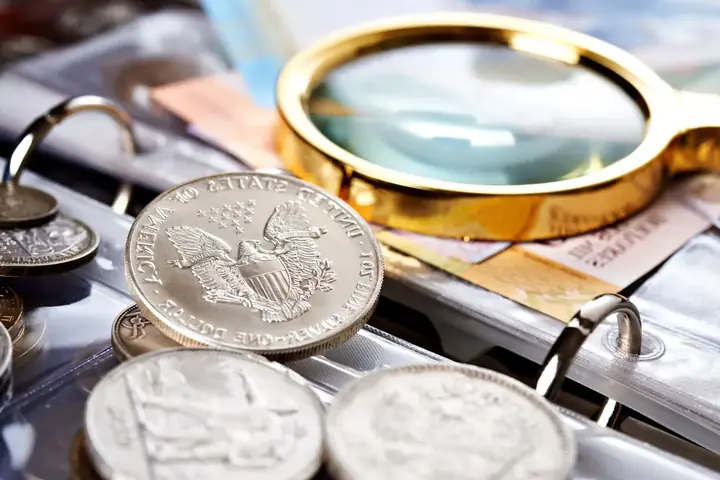
World coins in a Navy town
Between NAS Jacksonville, Naval Station Mayport and the submarine base just over the Georgia line at Kings Bay, generations of sailors have come home to Northeast Florida with pockets full of foreign coins. Those coins end up in coffee cans, footlockers and shadow boxes.
Most of what is in a typical bag is modern change worth very little. Mixed in, though, there is often some silver: old British florins, Mexican pesos, Spanish pesetas from the 1950s, Canadian dimes. We pull it out and price it.
How we sort a bag of world coins
First by metal, then by country. Silver and gold come out of the pile right away. Then we look at the older base metal coins for anything collectors pay for, and the modern change gets set aside.
Most bags end up with a small pile of silver, maybe a gold piece or two and a large pile of modern change. The written offer shows what we would pay for the silver and gold and any collector coins, and tells you plainly that the rest is souvenir value.
Silver dates by country
A quick guide to when some common countries stopped using silver in their everyday coins.
- Britain: silver until 1946, half silver from 1920
- Canada: 80 percent silver until 1966, some 1967 and 1968 coins too
- Australia: silver until 1963, plus 1966 round 50 cent pieces
- Mexico: silver in many pesos until the late 1960s
- Spain and Italy: silver commemoratives into the 1960s
- Philippines: silver pesos and halves from the U.S. era
Gold from overseas
Sailors and soldiers sometimes bought gold coins abroad as savings or gifts: British sovereigns, Mexican pesos, Turkish and Middle Eastern gold, Swiss francs and Chinese Pandas. Every one of them is bought on its gold content, and some carry premiums. We weigh and test each one with you.
Challenge coins and medals
Challenge coins are usually brass or bronze and carry little metal value. A few are silver, and some collectors trade them. Service medals belong with specialists or family more than with a metal buyer. We will point out any piece that is silver or worth more somewhere else.
Before a PCS move
If orders are coming and you would rather not ship another box of coins, call us early. We can find a time that works around the movers and the out-processing, and you leave with payment and a written list of what you sold.
Coins from the Philippines and Japan
Many Northeast Florida Navy families served in the Pacific, at Subic Bay, Yokosuka and Sasebo. Philippine coins from the American era, struck between 1903 and 1945, include silver pesos and halves that collectors like. Japanese coins from before the war include silver 50 sen pieces.
Postwar Japanese and Philippine coins are mostly base metal and carry little value. We sort them out quickly so you can see what matters.
World coins we buy
- Silver coins from Europe, Latin America and Asia
- British sovereigns and other world gold
- Canadian silver dollars and older Canadian coins
- Mexican silver pesos and gold coins
- Japanese, Korean and Philippine silver
- Coins from Spain, Italy, Greece and Bahrain
- Old world banknotes with collector value
How world coins are priced
Silver and gold world coins sell on their metal content first. Many older European and Latin American coins are 50 to 90 percent silver. Gold coins from almost any country are bought on the gold they hold.
Base metal coins, which is most coins struck after the 1960s, usually carry little value. A few older or scarce pieces are wanted by collectors, and we check for those before we tell you a bag is mostly souvenirs.
Further reading: Foreign coins from military service: what are they worth?
Questions families ask
Are foreign coins worth anything?
Silver and gold ones are. Most modern base metal coins are worth very little, and we tell you honestly which is which.
Do you buy foreign paper money?
Some older notes carry collector value. Most modern foreign notes are worth only their exchange value, which we cannot pay.
Do I need to sort them by country?
No. Hand us the bag as is; sorting it is our job.
Request a free appraisal
We call back the same day to find a time that works.